Introduction to the DSA Coding Patterns Series
Every developer I know who got genuinely good at algorithmic thinking did the same quiet thing at some point: they stopped memorizing problems and started collecting patterns. Not "here is the solution to Two Sum," but "here is the shape of problem that Two Sum belongs to, and here are its cousins." That shift, from a pile of solved problems to a small map of reusable shapes, is the whole point of this series.
What this series actually is
Textbooks tend to teach algorithms one clean problem at a time: one perfect input, one tidy solution, move on. Real work does not arrive that way. Whether it is an interview whiteboard, a competitive round, or a feature ticket in a production system, the problem shows up half-specified, the constraints are a little off from anything you have seen, and the winning move is almost never a whole algorithm recalled from memory. It is noticing that this piece of the problem is a sliding window, that piece is a heap, and snapping them together.
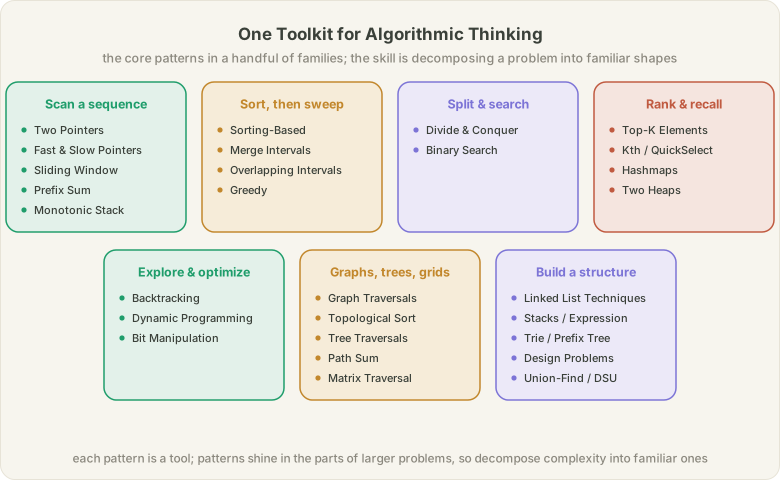
And that is the heart of it. Patterns rarely solve a whole problem by themselves; they shine in the parts of a larger one. The real skill this series is after is decomposition: taking something messy and creatively breaking it into familiar, manageable pieces, each of which is a pattern you already know. That habit pays off far beyond coding puzzles, in system design, in debugging, in any place where complexity needs taming. Interview prep is one use of it, and a good one, but the deeper aim is to make you a stronger engineer everywhere problems get hard.
So think of this as a reference for building that map. A toolkit of core patterns, each written so you can do three things:
- Recognize it fast, and know when to put it down. Every pattern has a trigger, the tell that you should reach for it, and an anti-trigger, the sign that it is the wrong tool. Both matter. A pattern forced onto a problem it does not fit is worse than no pattern at all, so this series is as honest about each one's costs and blind spots as about its strengths. No hammer syndrome here.
- Recall the shape under pressure. A short, correct implementation and a trace, so the mechanics live in muscle memory and not just in a diagram you saw once.
- See its neighbors. Patterns interlock. Sliding window leans on prefix sums, tree traversal feeds into backtracking, and knowing the links is how you handle a problem that needs two or three of them at once.
What it is not
It is not an exhaustive problem set with every variant solved, and it is not a stack of answers to memorize the night before an interview. If you memorize these as recipes, you will freeze the moment a problem is phrased in a way you have not seen. The aim is the opposite: enough grip on why each pattern works that you can bend it to fit an unfamiliar problem, on a whiteboard or in production, on the spot.
How to actually use it
If you are prepping for interviews, read a pattern and then go solve two or three problems that use it before moving on; the triggers only stick once you have felt one fire and watched an O(n^2) brute force collapse into something linear. If you are here to get sharper as an engineer, start noticing where these shapes already live in the systems you work on: a rate limiter is a sliding window, a build graph is a topological sort, an LRU cache is a hashmap married to a linked list. And if you are here to consult, each post stands alone: skim the trigger and the "where it shows up" list to jog your memory, and drop into the code only if you need the mechanics again.
One toolkit, not a bag of tricks
The first time through, the patterns feel like a pile of separate tools. By the end they start to feel like one toolkit for your algorithmic thinking, where each pattern is a tool and the more you understand how they interact, the more powerful the whole becomes. That is the note to leave on. Patterns shine in the parts of larger problems, and the real craft is decomposing complexity creatively into familiar, manageable pieces. Get good at that and you are not just readier for the next interview; you are a better engineer everywhere the problems are hard, which, if you are doing interesting work, is everywhere.
References
- Introduction to Algorithms (CLRS), 4th ed., Cormen, Leiserson, Rivest, Stein, 2022
- The Algorithm Design Manual, 3rd ed., Steven Skiena, 2020