Why the House Always Wins: Expected Value
"The probable is what usually happens." Aristotle, "Rhetoric"
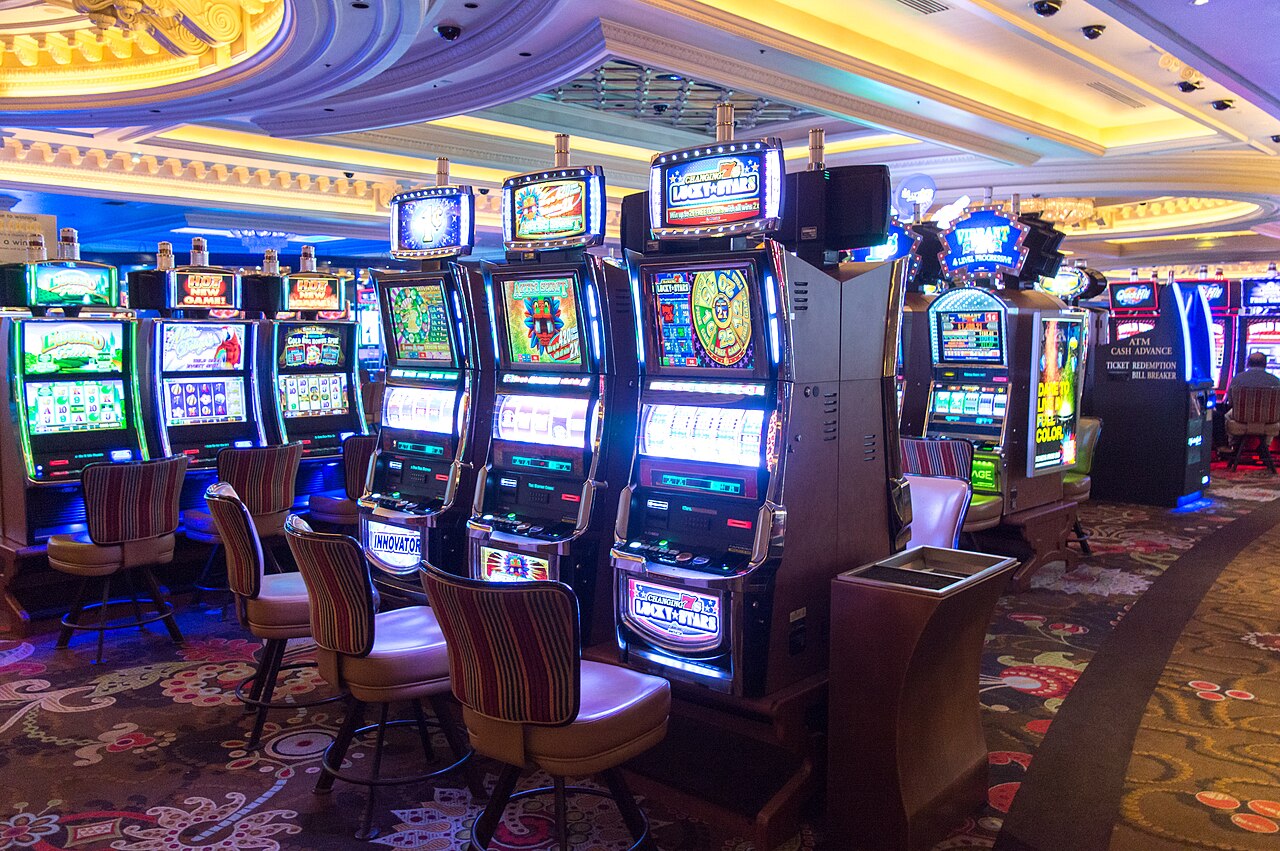
Photo: Tristan Surtel, CC BY-SA 4.0, via Wikimedia Commons.

A casino does not need to cheat. This is the first thing to understand, and it is more unsettling than the alternative. There is no loaded wheel, no marked deck, no thumb on the scale. The games are exactly as advertised. The wheel is fair, the dice are true, the deck is honest. And the house still wins, with the reliability of a law of physics, year after year, from millions of players who are not unlucky and not foolish.
How? The answer is a single number, hidden in plain sight inside every bet on the floor. Once you can compute that number, you can compute it for a lottery ticket, a loot box, a trading fee, and an insurance premium too, because it is the same number doing the same work in all of them. This post is about that number: what it is, why it is inescapable, and why knowing it is the first and most important tool of self-defense.
This is also the post where the series settles into its rhythm. Every entry from here on follows the same six movements: the phenomenon, the mathematical model, the psychological mechanism, the business strategy, the generalization, and the defense. Same skeleton, different machine each time. Let us walk it once, slowly.
1. The phenomenon
Walk onto a casino floor and you are surrounded by games that look winnable. People do win. The woman two seats down just hit, the lights are flashing, a small crowd has gathered. Winning is real, visible, and frequent enough to be believable. This is essential to the design: if nobody won, nobody would play. The casino is not in the business of preventing wins. It is in the business of making sure that wins, summed across everyone and everything, come to slightly less than what was wagered.
The industry even advertises this. A slot machine described as having a "96% RTP" is telling you its return to player: over the long run, it pays back 96 cents for every dollar fed in. That sounds almost generous, and it is meant to. But flip it around. The machine keeps 4 cents of every dollar, on every spin, from every player, forever. The number that matters is not the 96 you are shown. It is the 4 you are not invited to think about.
2. The mathematical model
The tool that captures this is expected value: the average outcome of a bet, weighted by how likely each outcome is. If a bet has possible payouts occurring with probabilities , its expected value is
That is the whole definition. It is the long-run average return per play: if you could repeat the bet a great many times, your total result divided by the number of plays would settle near this number. (Why it must settle, and how fast, is the deep section below. For now, take it as the average.)
Return to European roulette. Bet one dollar on a single number. With probability you win and receive 36 dollars back (your stake plus 35 in winnings); with probability you lose your dollar and receive nothing.
Your average return is 97.3 cents per dollar staked. Equivalently, your average loss is
Now notice something beautiful and terrible. Every other bet on a European wheel (red or black, odd or even, a corner of four numbers, a column of twelve) has a different payout and a different probability, yet they all collapse to the same 2.70% edge. Bet on red: probability , payout 2 for 1, expected return . Identical. The wheel is engineered so that the single green zero, that one extra pocket the payouts pretend does not exist, drains exactly from every wager no matter how you dress it. The house edge is not a property of any one bet. It is a property of the wheel.
This is the engine of the entire industry, and it has a name worth remembering: a game where for the player (equivalently, the price of a play exceeds its expected payout) is a negative expectation game. Casinos are, with rare and quickly-corrected exceptions, machines for offering negative-expectation bets at high volume.
The deep dive: why the average is destiny
The skeptic's objection is reasonable: the average is just an average. On any given night I might walk out ahead. Why is the long-run number my fate? The honest answer is that on any given night, you might indeed walk out ahead. The expected value does not govern one spin. It governs many. The bridge between "one spin is random" and "the year is certain" is the law of large numbers, and it is worth seeing why it bites.
Model your result on spin as a random variable , all independent and identically distributed, each with mean (for a one-dollar single-number bet, dollars) and finite variance . After spins your average result per spin is
The law of large numbers says as grows. To see how fast, look at the spread of that average. Because the spins are independent, variances add, so
There is the whole story in one line. Your total swing grows like (this is why a night of play can wander far from the average, and why people win), but your average result tightens around like . The randomness does not vanish; it gets diluted. And here is the asymmetry that runs the business: you play in the hundreds; the house plays in the hundreds of millions. For you, is large and the mean is just a faint pull. For the house, aggregating across every player and every machine, is essentially zero, and the mean is everything. You experience variance. The house experiences the law of large numbers. The casino is, quite literally, a device for converting your randomness into their certainty.
We can even ask: across spins, how likely am I to still be ahead? Your cumulative profit has mean and standard deviation . By the central limit theorem, for large the probability of being ahead is approximately
where is the standard normal CDF. Since , the argument marches toward as grows, and this probability slides toward zero. Play a little and your fate is mostly noise. Play a lot and your fate is the edge. The casino's only job is to keep you playing long enough for the second regime to arrive.
3. The psychological mechanism
If the average is so relentless, why does anyone play? Because human beings do not perceive expected value. We perceive outcomes and salience, and the casino arranges both.
A negative-expectation game can still be thrilling because the variance is real. The possibility of the big win is not a lie; it is just rare, and rarity is precisely what makes it vivid. We also suffer from availability: the jackpot is loud, lit, and broadcast, while the thousand quiet losses that paid for it are silent and private. Ask anyone who gambles and they can tell you about their biggest win in detail. The losses blur into an undifferentiated background. Our memory is a biased estimator of our own expected value.
There is also the matter of framing. "96% RTP" and "4% house edge" describe the identical machine, but the first invites you in and the second warns you off. Casinos, lotteries, and game publishers are extremely careful about which face of the number you are shown, because the math is fixed but the feeling is not. This will be a recurring theme: the term (information) in our general model is almost never neutral, and the gap between what is true and what is shown is where a great deal of the capture happens.
4. The business strategy
From the operator's side, a negative-expectation game is not a way to win bets. It is a way to price a product. The house edge is the margin, and the product being sold is the experience of playing. Three levers turn that margin into a reliable business.
Volume. As the deep section showed, profit certainty grows with the number of plays. So everything is tuned to maximize plays per hour: fast spins, nearby machines, free drinks to keep you seated, no clocks, no windows. The edge is fixed; the strategy is to harvest it more times.
Tuning the edge to taste. Different games carry different edges (roulette around 2.7%, some slots 10% or more, blackjack under 1% for a skilled player) and operators choose the mix deliberately. A low-edge game that feels winnable is a loss leader that keeps you on the floor near the high-edge machines. The RTP of a modern slot is not a fixed law of nature; it is a configurable parameter, often selectable by the operator, dressed in art so the player cannot feel the difference between a 92% machine and a 96% one.
Comps and reinvestment. A casino that takes 4% of enormous volume can afford to give a slice back as free rooms, meals, and loyalty points, which feel like winnings and increase volume further. The edge is large enough to fund its own marketing.
5. The generalization
Here is where this stops being about casinos. The expected-value lens fits anything that charges you for a chance at a reward. Once you start looking, the negative-expectation structure is everywhere, often in places that do not advertise themselves as gambling at all.
- Lotteries are the purest case. A typical state lottery returns roughly 50 cents on the dollar, a house edge an order of magnitude worse than roulette, sustained entirely by an enormous, vivid jackpot that dominates the imagination while the dismal expected value goes unfelt.
- Loot boxes and gacha are negative-expectation bets where the payout is a digital item. We will open the drop table in a later post, but the skeleton is identical: pay a fixed cost for a random reward whose expected value, in any currency you actually care about, is engineered to sit below the price.
- Trading fees and spreads apply the edge to a market. Even if the underlying asset is a fair bet, every round trip pays a fee, and that fee is a house edge levied on volume. An interface that maximizes your number of trades is maximizing exactly the quantity the casino maximizes: . We devote a whole post to this.
- Insurance is the same machine pointed the other way, and this is the clarifying case. Your premium has negative expected value for you (the insurer would not sell it otherwise); the company keeps the edge. The difference is what you buy with that edge: insurance converts a small certain loss into protection against a catastrophic uncertain one, which for a risk-averse person is a genuinely good trade. Same negative-expectation structure, opposite verdict. Expected value alone never tells you whether to play. It tells you who profits, and how much you are paying for whatever else the bet provides.
That last point matters, so let me sharpen it. A negative expected value is not automatically a reason to refuse. It is a reason to ask what you are buying with the difference. With insurance you are buying peace of mind and ruin-protection, and the price can be fair. With a lottery ticket you are buying a few days of permission to daydream, and only you can say if a dollar is worth that. With a slot machine you are buying entertainment by the minute, and the edge is the ticket price. The expected value does not forbid the purchase. It just makes the price tag legible.
6. The defense
So what do you actually do with this? The defense built on expected value is not "never play." It is a habit of mind, and it comes down to three moves.
Compute the edge, or find it. Before any repeated bet, ask: what is the expected value, and who keeps the difference? Often the number is published (RTP, lottery payout ratios, fund expense ratios) and you simply have to flip it from the flattering face to the honest one. Four percent kept per play is the same fact as 96% returned, but only one of them tells you what the game costs.
Separate the one play from the many. Expected value governs the long run, so the defense is to know which run you are in. A single lottery ticket as a bit of fun is a one-shot bet where variance dominates and the edge barely matters. A daily lottery habit is a long run where the edge is destiny and variance is a distraction. The same is true of slots, loot boxes, and trades. The danger is never the single play; it is the volume, because volume is exactly what converts your variance into someone else's certainty.
Decide what you are buying, then pay on purpose. If a negative-expectation bet buys you something you genuinely value (an evening's entertainment, insurance against ruin, the small thrill of a long shot) then pay for it deliberately, with a fixed budget, the way you would pay for a concert ticket. The trap is never the entertainment. The trap is paying for entertainment while believing you are investing, and then letting volume do the rest.
Expected value is the foundation, but it is not the whole building. It explains why the house wins on average, given enough plays. It does not yet explain why a player keeps playing until those plays accumulate, nor why a player with limited money can be destroyed even by a fair game where the edge is zero. For that we need to follow the money through time, not just on average. That is the gambler's ruin, and it is where we go next.
Next in the series: Time Until Ruin, where a fair game still bankrupts you, and finite capital becomes its own house edge.